7 Gentle Sciatica Stretches to Try at Home (and Where Sciaticyl Fits)
Disclosure: DailyWiser is reader-supported. If you buy through links on this page, we may earn a commission at no extra cost to you. Learn more.
Sciatica, the pain that travels from the lower back or buttock down the back of one leg, can turn simple things like sitting at a desk or getting out of the car into a chore. The good news is that, for many people, it settles with time, gentle movement and sensible self-care. The NHS notes that sciatica usually gets better within 4 to 6 weeks, although it can last longer.
This guide walks through seven gentle, widely recommended stretches you can try at home, with simple safety cues for each one. At the end we take a brief, honest look at Sciaticyl, a supplement marketed for sciatic nerve comfort, and explain why it should never replace the basics below.
This is a research-based guide. We have not personally tested Sciaticyl; product details reflect its official sales page and our earlier Sciaticyl review.
Quick Takeaways
- Gentle stretching and staying active are standard self-care for most mild sciatica.
- Move slowly, breathe normally and stop if pain shoots further down your leg.
- Not every stretch suits every cause; a physiotherapist can tailor a routine to you.
- No supplement has been shown to cure sciatica. Red-flag symptoms need urgent care.
Before you start: simple safety rules
- Go gently. Aim for a mild, comfortable stretch, never sharp pain. Hold each stretch for about 20 to 30 seconds unless noted, and repeat 2 to 3 times per side.
- Watch your leg symptoms. If pain, tingling or numbness spreads further down the leg during or after a stretch, stop that stretch. Symptoms that move back toward the lower back are generally a better sign, but ask your clinician how to read your own response.
- Use a firm, comfortable surface such as an exercise mat on the floor, or a firm bed if getting down to the floor is difficult.
- Do not bounce or force a position. Breathe slowly throughout.
- Little and often usually works better than one long session. Short walks through the day help too.
1. Knee-to-chest stretch
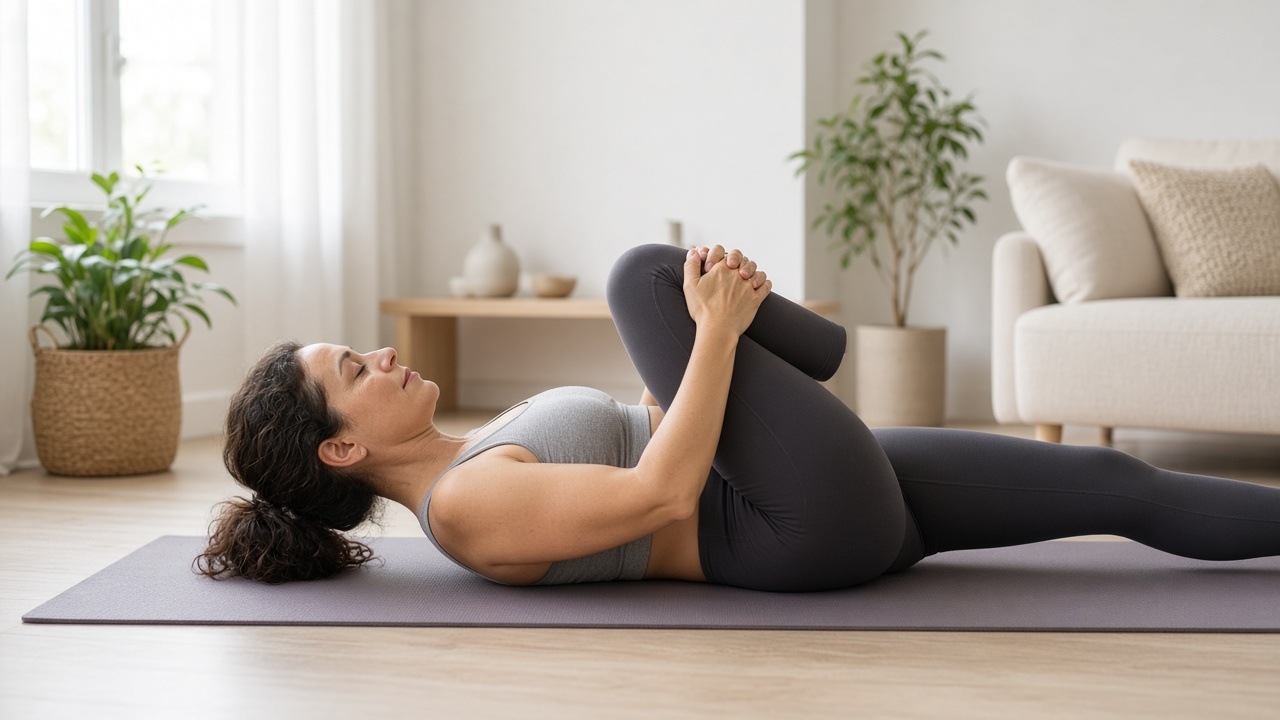
Lie on your back with both knees bent and feet flat. Hold behind one thigh (or over the shin if comfortable) and gently draw that knee toward your chest until you feel a mild stretch in the lower back and buttock. Keep the other foot on the floor. Hold for 20 to 30 seconds, then switch sides.
Safety cue: keep your head and shoulders relaxed on the mat. If pulling one knee feels too strong, place a towel behind the thigh and pull on the towel instead.
2. Lying piriformis stretch (figure-4)
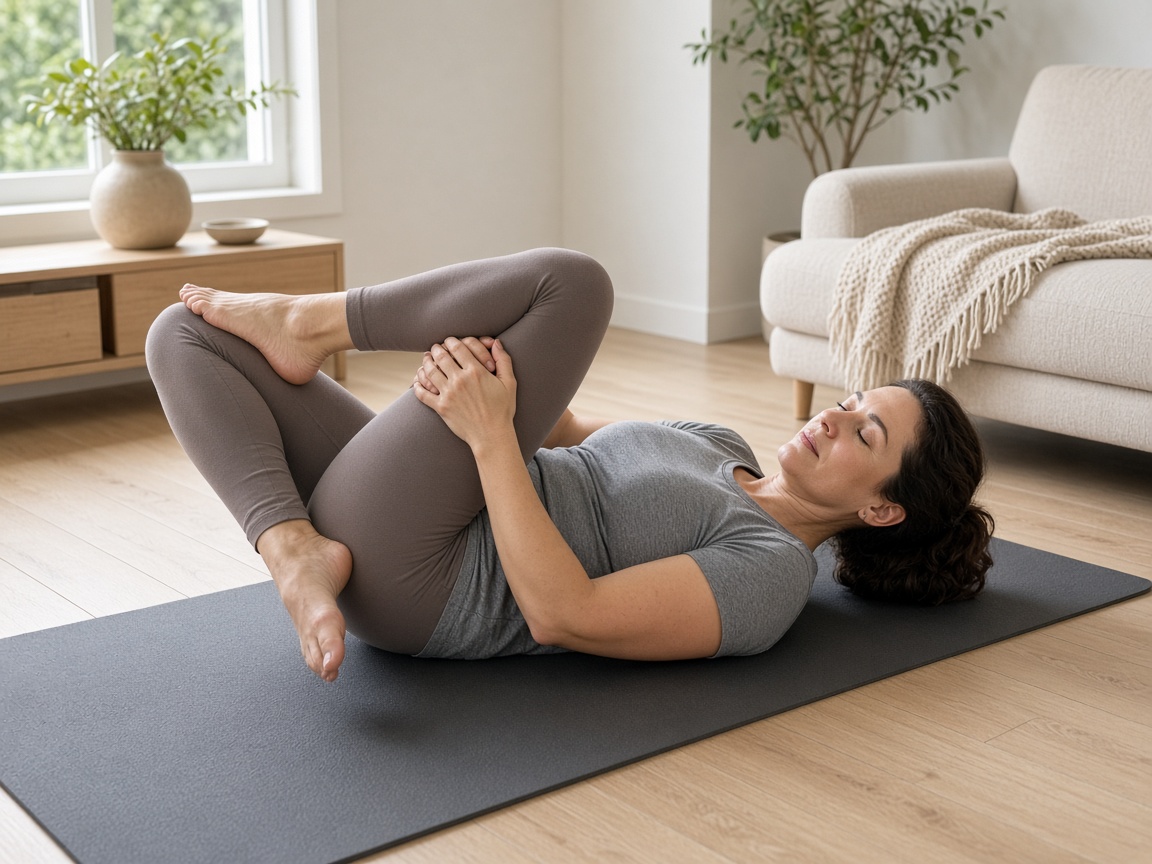
The piriformis is a small muscle deep in the buttock that sits close to the sciatic nerve. Lie on your back with both knees bent. Cross your right ankle over your left knee to make a “4” shape. Reach through and hold behind your left thigh, then gently draw it toward you until you feel a stretch in the right buttock. Hold, then switch sides.
Safety cue: keep your lower back and tailbone on the mat. If you cannot reach your thigh comfortably, loop a strap or towel around it, or simply let the crossed leg rest without pulling.
3. Seated piriformis stretch
This is a good option if you sit for long periods or find it hard to get down to the floor. Sit tall near the front of a sturdy chair with both feet flat. Place your right ankle on your left knee. Keeping your back straight, hinge forward slightly from the hips until you feel a stretch in the right buttock. Hold, then switch sides.
Safety cue: lean only a little; the stretch comes from the hip hinge, not from rounding your back. Use a chair without wheels.
4. Pelvic tilt
Lie on your back with knees bent and feet flat, hip-width apart. Gently tighten your stomach muscles and flatten your lower back into the floor, letting the pelvis tilt slightly upward. Hold for about 5 seconds, relax, and repeat 8 to 10 times.
Safety cue: this is a small movement. Keep your buttocks on the floor and do not hold your breath.
5. Cat-cow
Start on your hands and knees, with hands under shoulders and knees under hips. Breathe in and let your stomach drop gently as you lift your head (cow). Breathe out and slowly round your back toward the ceiling, tucking your chin (cat). Move between the two positions slowly for 8 to 10 rounds.
Safety cue: work only in a comfortable range. Place a folded towel under your knees if they feel sore. Some people with sciatica feel worse with repeated bending; if rounding your back increases leg symptoms, skip the “cat” part and ask your physiotherapist.
6. Gentle hamstring stretch with a strap
Lie on your back with both knees bent. Loop a strap, belt or towel around the ball of one foot and slowly straighten that leg toward the ceiling until you feel a light stretch along the back of the thigh. The other foot can stay flat on the floor. Hold for 20 to 30 seconds, then switch.
Safety cue: this stretch can also tension the sciatic nerve, so keep it mild. Do not pull your toes toward you, and stop if you feel tingling, burning or pain running down the leg.
7. Child’s pose
Kneel on the mat, big toes together and knees apart. Sit your hips back toward your heels and walk your hands forward, letting your chest lower toward the floor. Rest your forehead on the mat or a cushion and breathe slowly for 20 to 30 seconds.
Safety cue: place a pillow between your hips and heels if you cannot sit back comfortably. As with cat-cow, skip it if forward bending makes your leg symptoms worse.
Watch: physical therapists demonstrate sciatica stretches
In this video, physical therapists Bob Schrupp and Brad Heineck of the Bob & Brad channel demonstrate stretches for piriformis-related and sciatic pain. Watch it before you try anything new, and follow your own clinician’s advice if it differs.
Other self-care that helps
Stretching works best as part of a wider routine. Commonly recommended steps include staying as active as you can (gentle walking is generally better than long bed rest), taking regular breaks from sitting, using heat or cold packs for short-term comfort, and using over-the-counter pain relief as advised by a pharmacist. Cleveland Clinic and Mayo Clinic both have clear overviews of causes and treatment options.
See your doctor if pain is severe, lasts more than a few weeks, keeps coming back or is getting worse. They can look for the cause, which is most often a herniated (slipped) disc or narrowing in the spine, and discuss options such as physiotherapy, prescription medication, injections or, in some cases, surgery.
Where Sciaticyl fits
Sciaticyl is a capsule supplement sold online for sciatic nerve comfort. On its official page, the vendor says to take two capsules a day and describes one bottle as a 30-day supply, priced at $69 when we checked. It says the formula combines 11 vitamins, minerals and herbs, but the page we reviewed did not list each ingredient and dose. The vendor describes a 90-day money-back guarantee and says it is a one-time purchase, not a subscription.
We found no published clinical trial of the finished product, and some of its marketing uses cure-style language we could not support. So we see it, at most, as an optional extra for adults who have already seen a doctor, are doing their exercises, and have had the full label checked by a pharmacist for interactions. It is not a replacement for movement, physiotherapy or medical care. For the full breakdown, read our Sciaticyl review.
- May suit: adults with a diagnosis who want to try a supplement alongside medical advice, within the refund window
- Skip if: you have red-flag symptoms, are pregnant or breastfeeding, take regular medication without advice, or expect a cure
Check Sciaticyl on the official site
Frequently asked questions
How often should I do sciatica stretches?
Many people do a short routine once or twice a day, plus regular gentle walks. Your physiotherapist can suggest the right amount for you.
Should stretching hurt?
No. A mild pulling sensation is fine, but sharp pain, or pain, tingling or numbness spreading further down the leg, is a signal to stop that stretch.
What if the stretches make my sciatica worse?
Stop the stretches that aggravate it and speak to a doctor or physiotherapist. Different causes respond to different movements, so a tailored plan matters.
Can a supplement cure sciatica?
No supplement has been shown to cure sciatica. Most cases improve with time, activity and exercise; persistent cases need medical assessment.
Bottom line
Gentle, regular stretching, short walks and fewer long stretches of sitting are some of the simplest things you can do for mild sciatica. Start slowly, respect your symptoms and get a physiotherapist’s input if you can. A supplement such as Sciaticyl is optional at best and should only ever sit alongside, not instead of, proper care.
Affiliate disclosure: DailyWiser is reader-supported. If you buy through links on this page, we may earn a commission at no extra cost to you. This guide is based on research of publicly available information and is not paid for by vendors.
Similar Posts
How to Improve Memory Naturally: 9 Evidence-Based Habits (and Where MindVault Fits)
Nine evidence-based habits that support memory and brain health as you age, the warning signs that need a doctor, and an honest look at where the MindVault supplement fits.
Pianoforall Review 2026: Is It Worth It for Beginners?
Pianoforall teaches piano through chords and rhythm styles. We cover what you get, the $49 price, the 60-day refund policy, pros and cons, and how it compares with apps and teachers.
Woodworking Tools for Beginners: A Starter List for a Small Shop (2026)
A practical starter list of woodworking tools for beginners working in a garage, shed or spare room: what to buy first, what can wait, and where the UltimateSmallShop guide fits.
How to Save Your Marriage When Only One Spouse Is Trying (8 Practical Steps)
Eight practical, research-informed steps for the spouse who still wants to try, the situations where self-help is the wrong tool, and an honest look at where the Save The Marriage program fits.
Small Woodworking Shop Layout: 7 Space-Saving Ideas
Seven practical ideas for laying out a small woodworking shop in a garage, shed or basement, plus where the UltimateSmallShop planning guide fits.