In an Emergency, Would You Know Where Everything Is?
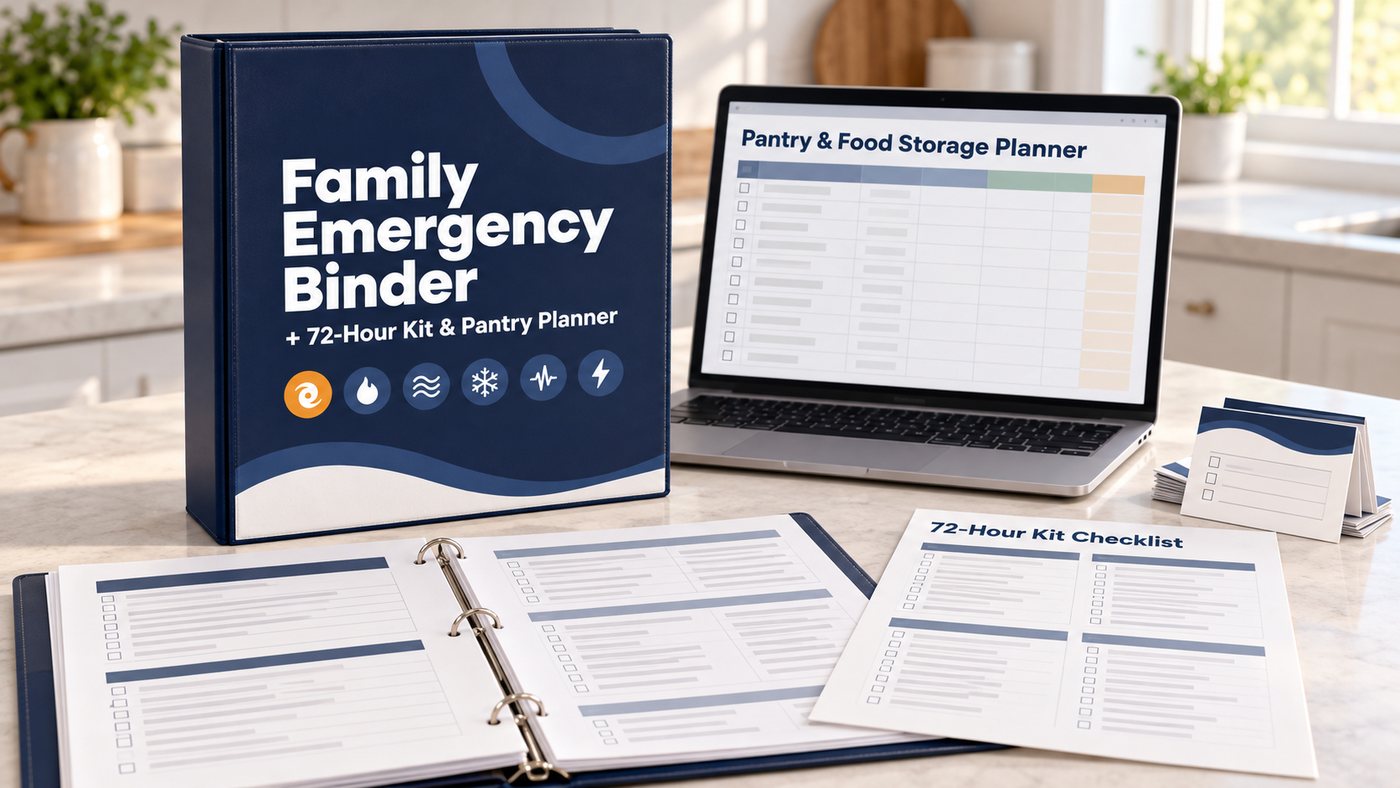
Your important information is probably somewhere. But could you find what you need when it matters?
Watch the 80-second overview
Think about how much information your household depends on every day.
Your medical details might be stored in an app. Insurance documents could be buried in your email. Important phone numbers might be saved on different devices. Birth certificates, passports, and other paperwork may be tucked away in a drawer, filing cabinet, or storage box.
And your family’s emergency plan?
Maybe you’ve talked about making one.
Maybe you’ve downloaded a checklist, saved a helpful article, or bookmarked a government preparedness website.
But turning all that information into one organized, practical plan is another matter.
When something unexpected interrupts your normal routine, you don’t want to start searching through emails, guessing where documents are kept, or trying to remember what you meant to prepare.
You want to know where your important information is.
You want clear instructions your household can understand.
And you want a simple way to check what you already have, what you still need, and what deserves attention next.
Not because you expect something bad to happen.
But because having a plan can make ordinary life feel a little more manageable.
You Don’t Need More Preparedness Advice. You Need a Place to Put It.
There is no shortage of emergency preparedness information.
You can search online for evacuation checklists, emergency contact templates, pantry storage ideas, and recommendations for household supplies.
Official organizations publish useful guidance, too.
The challenge usually isn’t finding another article.
It’s taking the information you find and organizing it into something your own household can actually use.
Perhaps you’ve wondered:
- Where should you keep important household and medical information?
- What should you include in a 72-hour emergency kit?
- How can you prepare supplies for children, older adults, or pets?
- What belongs in an emergency go-bag versus your car?
- How much water should you plan to store?
- How can you track pantry supplies without repeatedly buying things you already have?
- What should you review before a winter storm, wildfire, flood, or extended power outage?
Each question seems manageable on its own.
But when you try to organize everything at once, the project can quickly become overwhelming.
You start with good intentions. You open a document, make a few lists, and promise yourself you’ll finish later.
Then everyday life gets busy.
The unfinished plan remains on your computer.
The printed checklist stays in a drawer.
And your household information remains scattered across different places.
What if you could stop building everything from scratch and simply start filling in the information that matters to you?
Why Another Free Checklist — or an AI-Generated Document — Might Not Solve the Problem
Free resources are valuable.
In fact, official preparedness websites are excellent places to learn about local hazards, recommended supplies, and emergency procedures.
AI tools can also help you brainstorm questions, summarize guidance, and create basic planning lists.
You don’t have to stop using either.
But there’s a practical difference between receiving advice and having an organized system ready to complete.
A typical checklist might tell you to gather emergency contacts.
It may not give you a dedicated, reusable place to organize those contacts alongside your household details, important document locations, medical information, and evacuation plans.
An AI-generated list can give you a useful starting point.
But you may still need to decide what sections to create, how to arrange them, what information belongs together, and how to make the finished document easy for someone else to navigate.
You could absolutely do all that work yourself.
The question is whether you want to spend your time designing the system or actually completing your household’s plan.
A ready-to-fill binder removes much of the blank-page work.
Instead of starting with a collection of unrelated documents, you begin with a consistent structure.
Instead of wondering what to include next, you move through clearly labeled sections.
And instead of keeping food storage, emergency contacts, important documents, and household procedures in separate unfinished projects, you have a coordinated set of planning tools.
That’s the difference this kit is designed to offer.
Introducing the Family Emergency Binder + 72-Hour Kit & Pantry Planner
One organized digital planning kit for the information, checklists, and household supplies you want to keep track of.
The Family Emergency Binder + 72-Hour Kit & Pantry Planner brings several everyday preparedness tasks together in one downloadable package.
It’s designed for families and households in the United States, Canada, and Australia who want a practical way to get organized without spending hours creating templates from scratch.
For USD17, you receive the complete digital kit, including a fillable emergency binder, printable supply checklists, wallet cards, a pantry planning spreadsheet, and quick-start resources.
You can complete the binder on screen or print it and write by hand.
You can work through it gradually.
You can revisit it when household details change.
And you can use the included tools to build a plan that reflects your actual circumstances rather than relying on a generic list.
The materials are informed by public preparedness guidance from Ready.gov/FEMA, the American Red Cross, Get Prepared Canada, and the Australian Red Cross.
The guidance is presented in original, plain wording, with a references page so you can consult the official sources.
This kit doesn’t promise to make every situation predictable. It gives you a clear place to start organizing the things you can plan ahead.
Here’s Exactly What’s Inside Your Digital Download
1. Family Emergency Binder — 59 Fillable Pages
This is the central planning document.
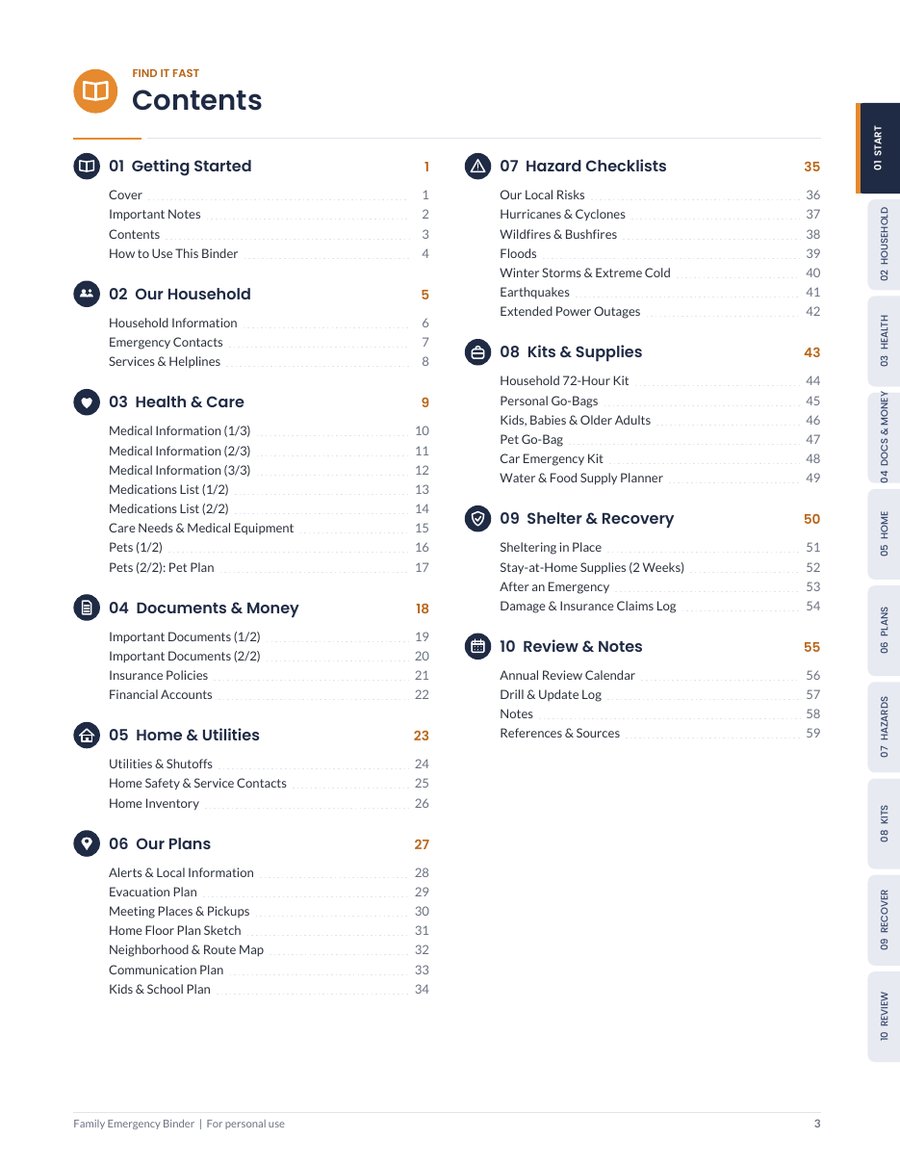
Rather than giving you an empty notebook and asking you to create your own system, the binder provides 59 organized, fillable pages across 10 tabbed sections.
| Section | What you’ll organize |
|---|---|
| 01. Getting Started | Your starting point and how to use the binder |
| 02. Our Household | Household members, contacts, and essential details |
| 03. Health & Care | Relevant health information and care considerations |
| 04. Documents & Money | Important records and where to locate them |
| 05. Home & Utilities | Household information and utility details |
| 06. Our Plans | Emergency communication and household arrangements |
| 07. Hazard Checklists | Planning prompts for different types of emergencies |
| 08. Kits & Supplies | Your essential supplies and kit preparations |
| 09. Shelter & Recovery | Considerations for sheltering and returning to routines |
| 10. Review & Notes | Updates, reminders, and additional information |
The binder also includes a clickable table of contents and PDF bookmarks, making it easier to move between sections when you’re using a compatible PDF reader.
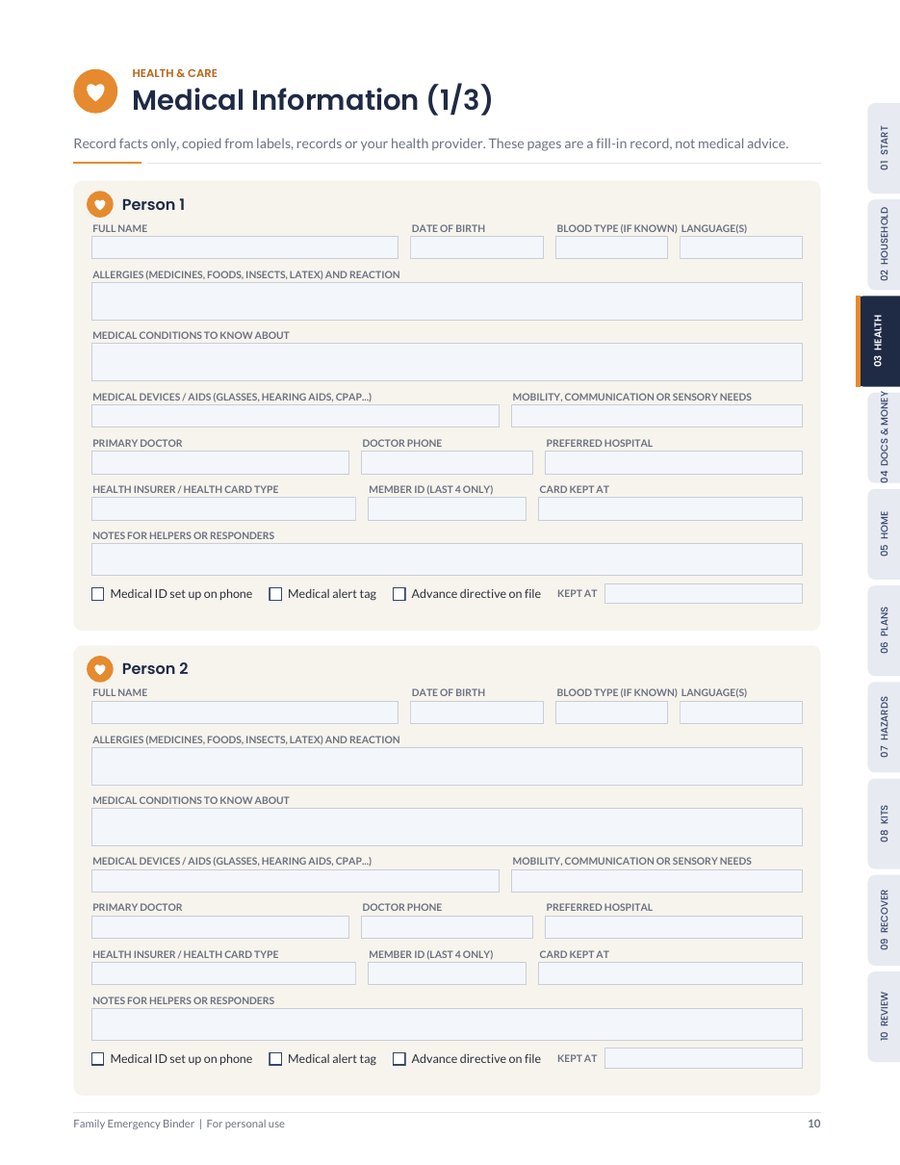
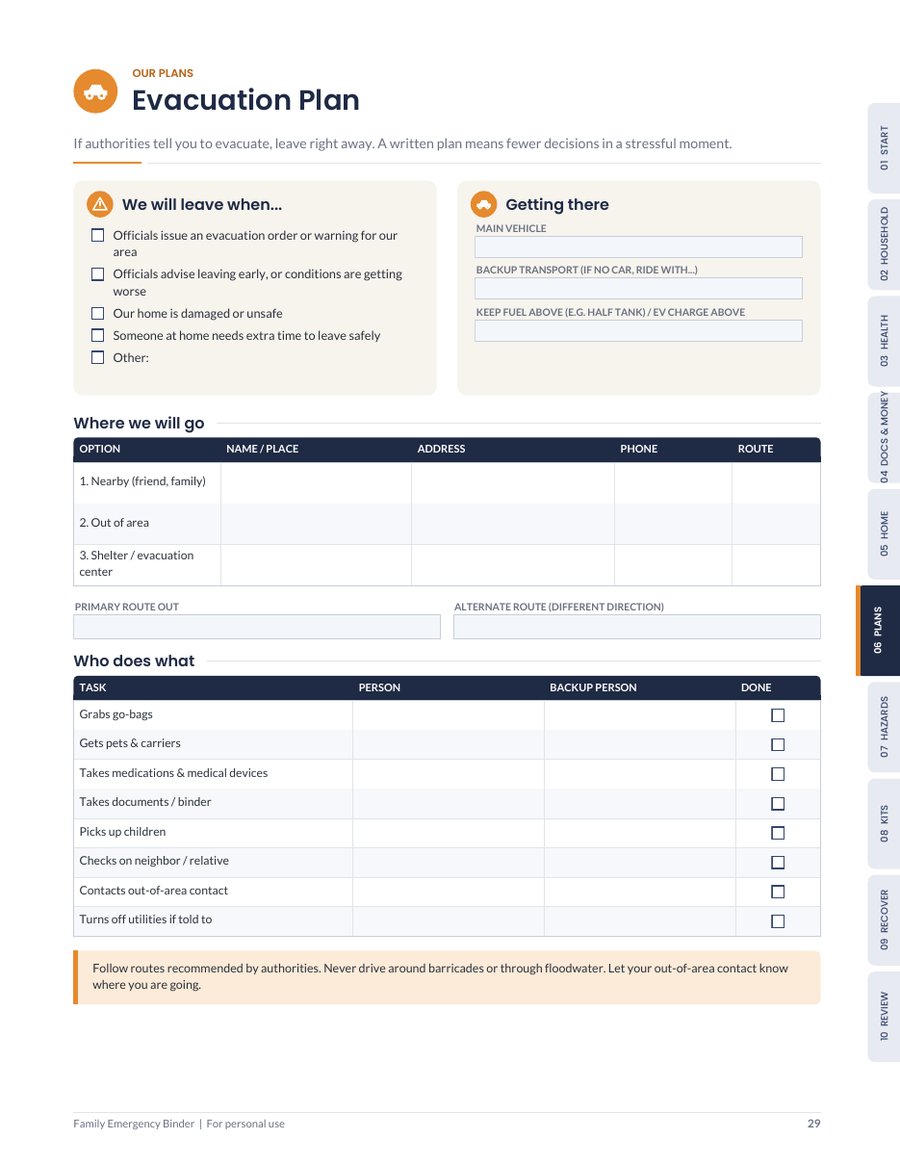
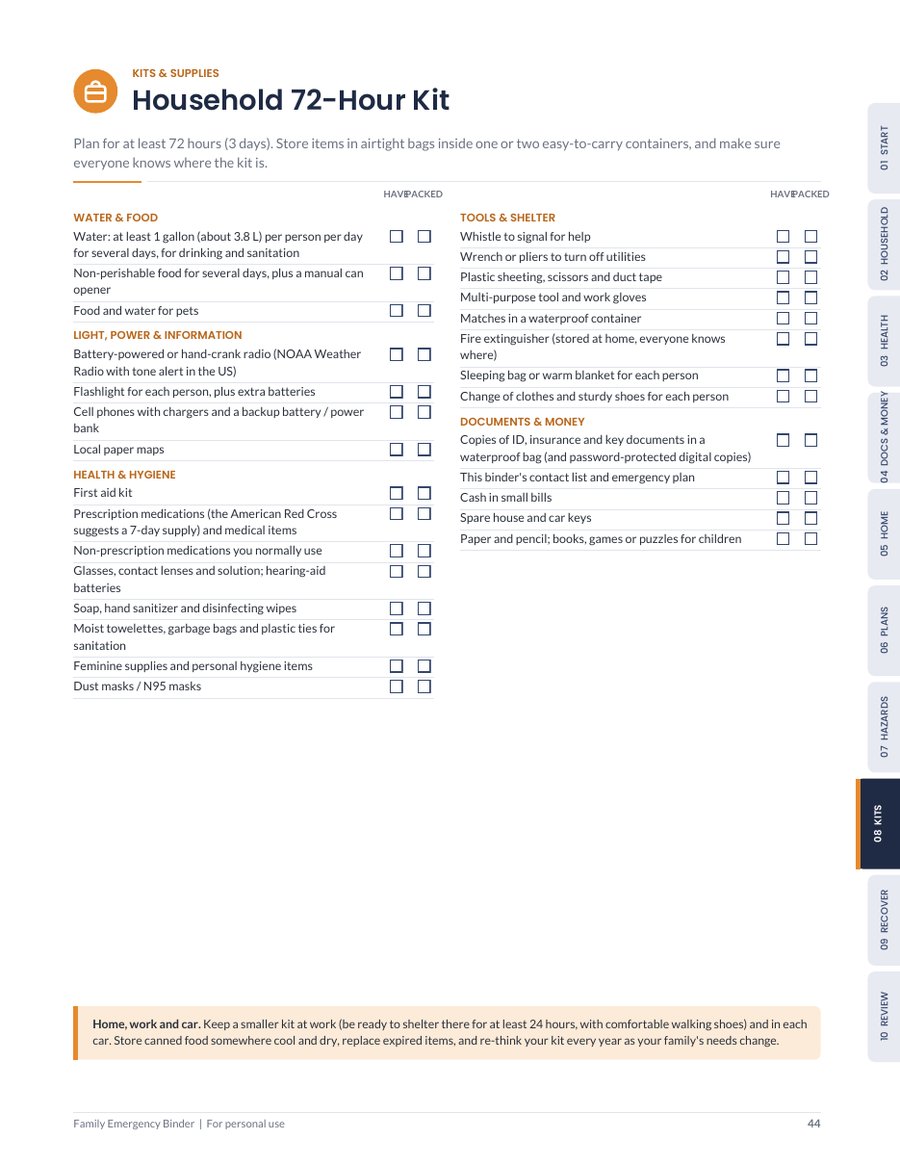
You don’t need to complete every page immediately.
Begin with your household’s most useful information, then build from there.
Importantly, the binder advises you never to write full account numbers or passwords in it.
You can record appropriate reference details and document locations without turning your emergency binder into a collection of highly sensitive credentials.
2. 72-Hour Kit Checklist — 6 Printable Pages
Preparing basic emergency supplies is easier when you can see what you already have and what’s still missing.
This six-page printable checklist helps you plan essential items without depending on memory.
It includes a six-person go-bag matrix, allowing you to organize supplies for different household members.
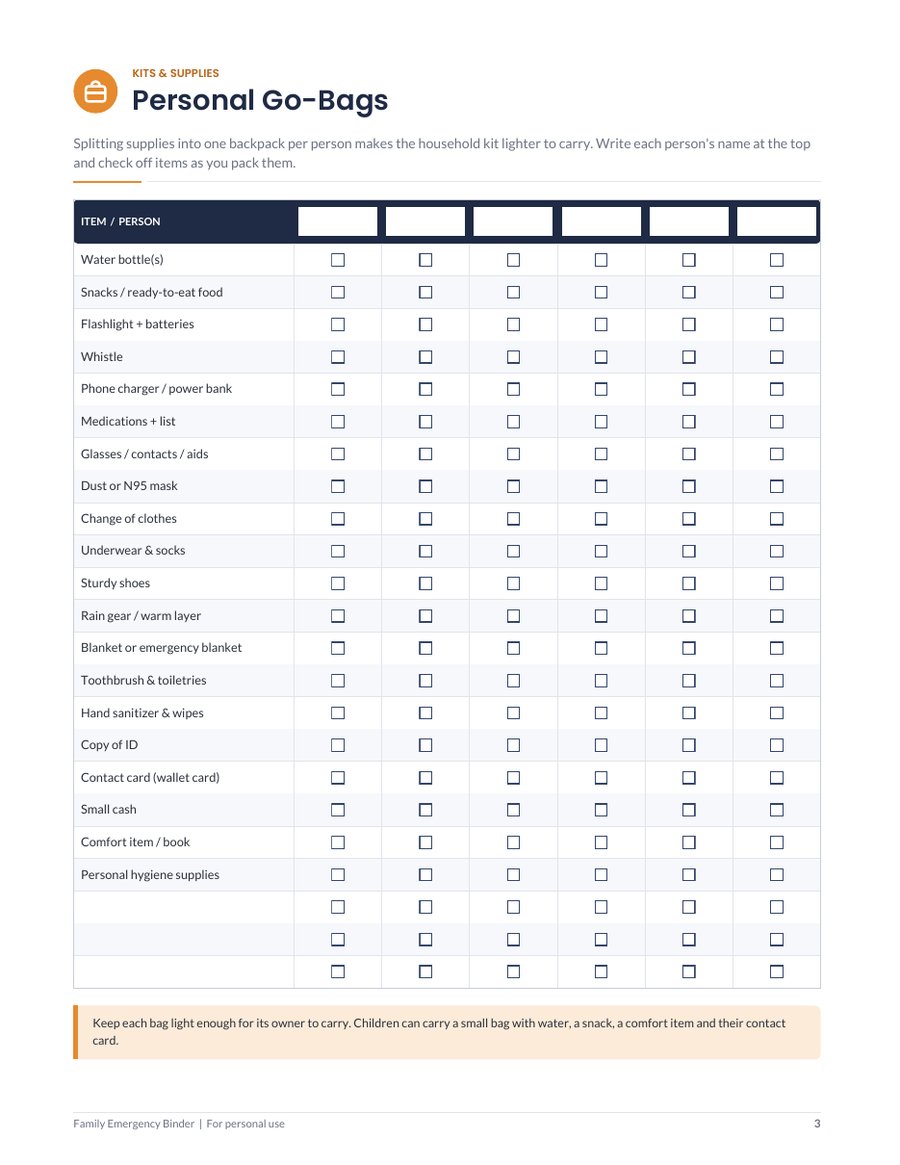
You’ll also find dedicated lists for:
- Children and babies
- Older adults
- Pets
- Your car
- General emergency kit supplies
You can adapt these lists to your household’s needs, health considerations, climate, and local recommendations.
There is no expectation that every family needs the exact same kit.
The point is to make it easier to identify gaps, prepare gradually, and review what you’ve assembled.
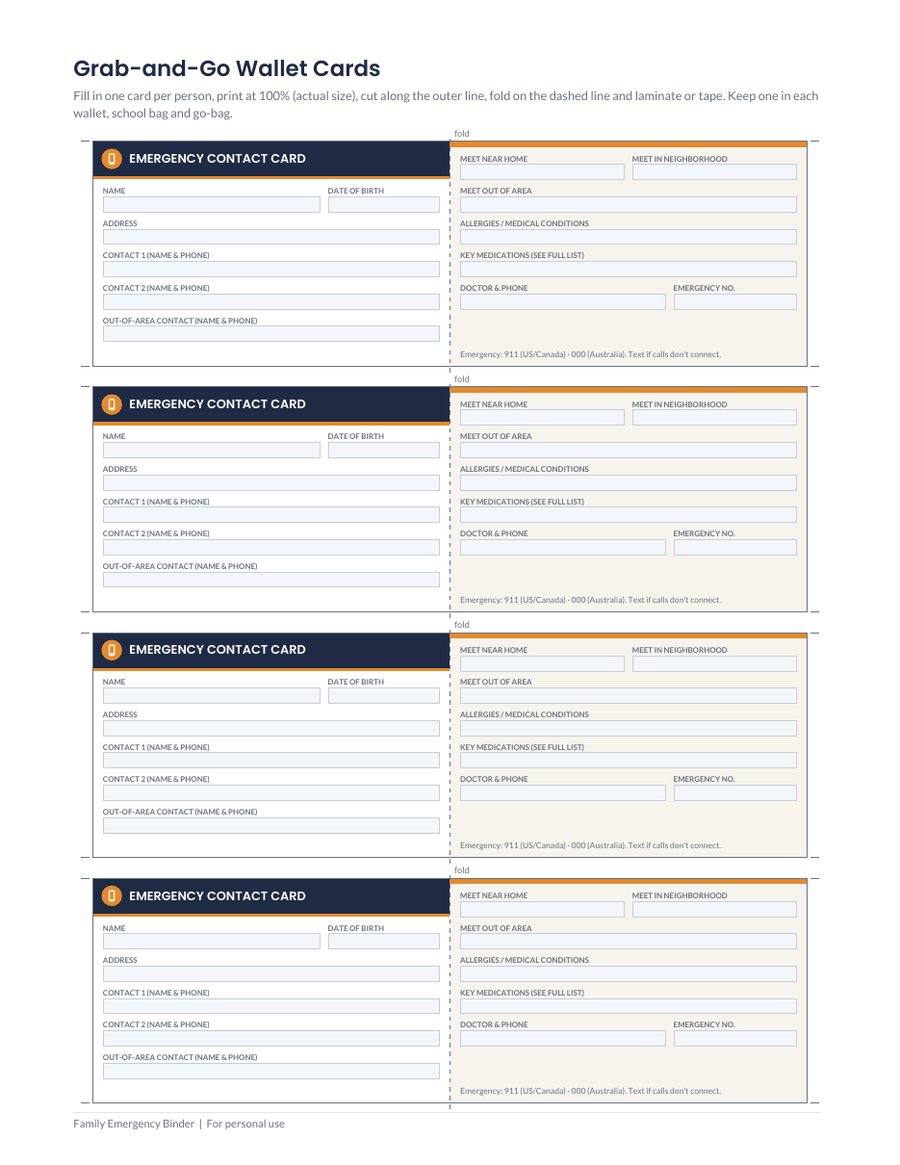
3. Grab-and-Go Wallet Cards — 4 Fillable Fold-Over Cards
Important contact details aren’t always convenient to retrieve from a phone.
These four fillable, fold-over wallet cards provide a compact way to keep selected information accessible.
You can fill them in digitally, print them, fold them, and place them somewhere convenient.
They may be especially useful when planning how household members can access important contacts without relying entirely on a device.
Choose carefully what personal information you include, and keep the cards in an appropriate place.
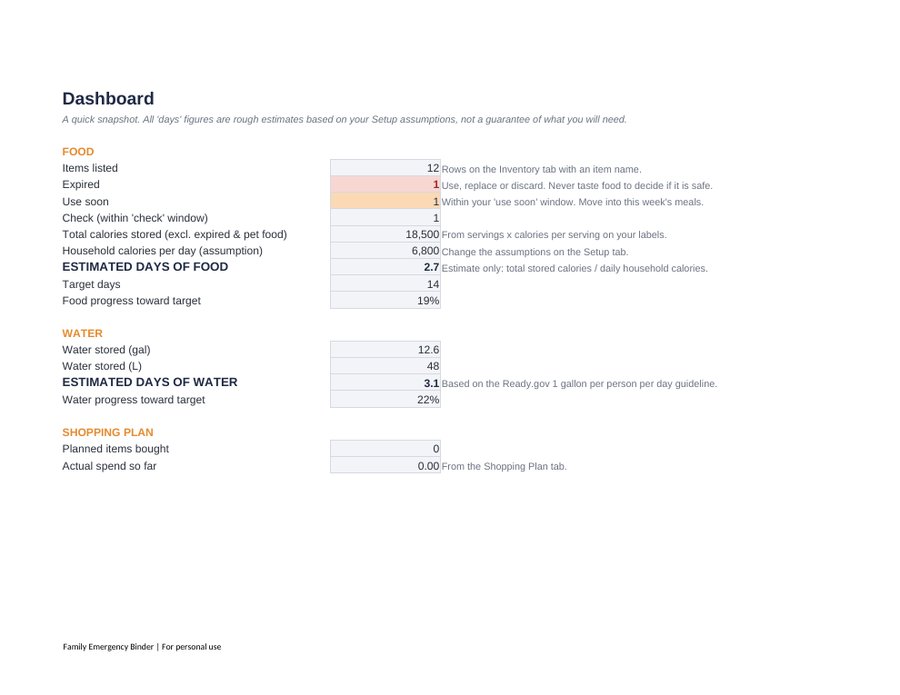
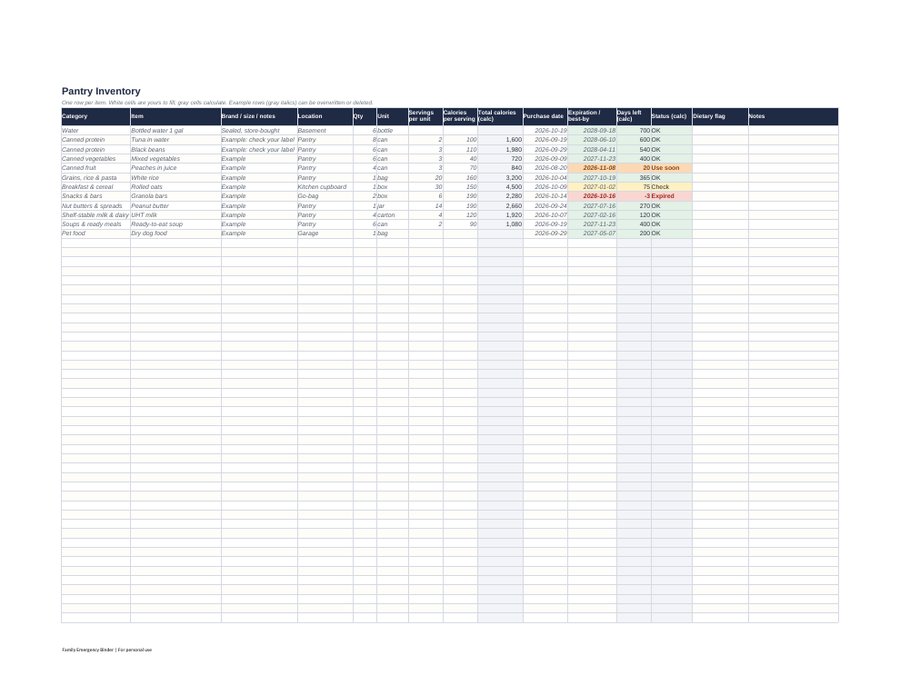
4. Pantry & Food Storage Planner — Excel / Google Sheets
Buying additional pantry supplies is only one part of food storage planning.
Knowing what you already own, when items should be checked, and what needs replacing is just as useful.
The included spreadsheet helps you turn an unorganized collection of supplies into a trackable household inventory.
It includes:
- Pantry inventory: Record the food and other supplies you have on hand.
- Expiry alerts: Identify items approaching their recorded expiry dates so you can review them.
- Water calculator: Plan water quantities using the Ready.gov baseline of one gallon per person per day, while checking whether your household and local guidance call for more.
- Three-month shopping plan: Spread purchases over time instead of trying to buy everything at once.
- Rotation log: Track items used and replaced so supplies are less likely to sit forgotten.
The planner works with Microsoft Excel and Google Sheets.
It’s particularly useful if you prefer to build your pantry gradually, keep shopping organized, or reduce unnecessary duplicate purchases.
5. Bonus: Emergency Binder Quick Start — 1 Page
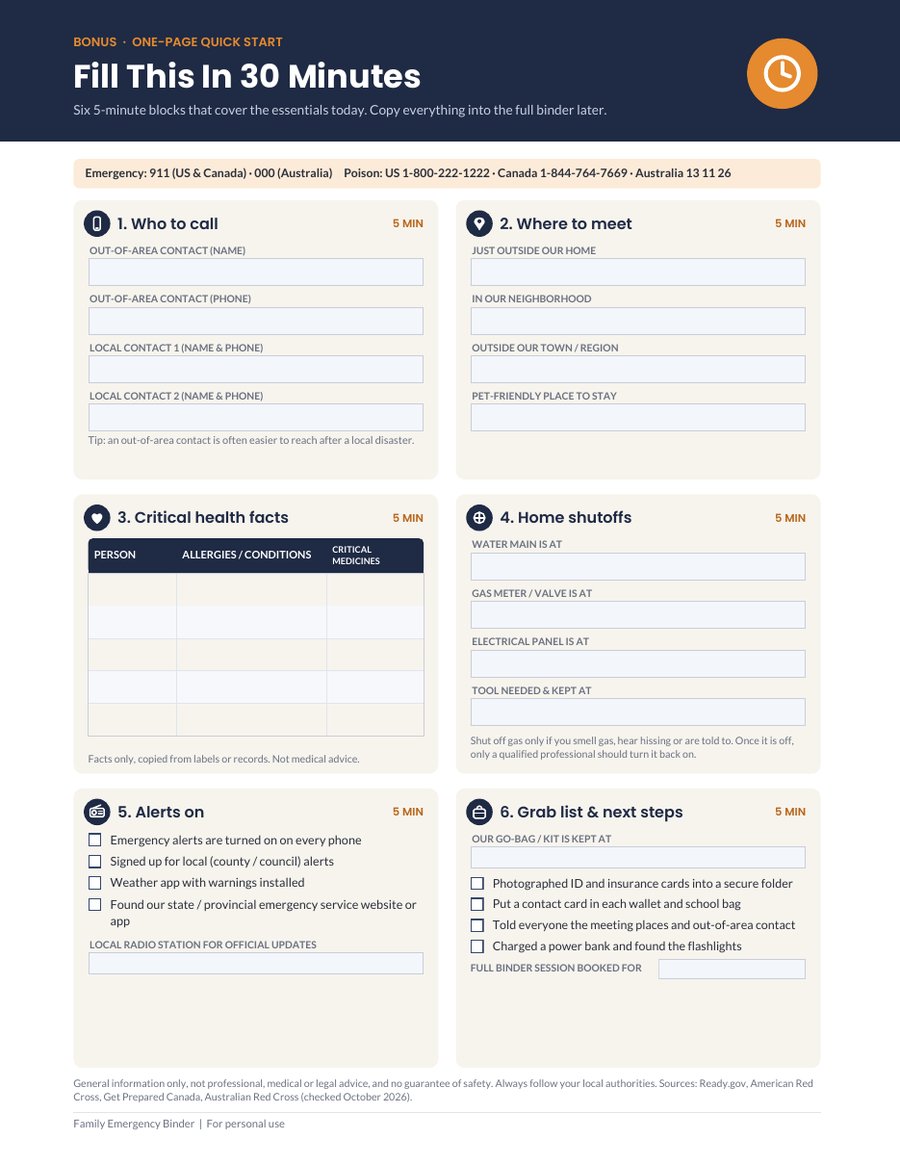
Not sure where to begin?
This one-page guide provides a simple 30-minute starting routine.
You don’t need to finish the entire binder during that session.
The goal is to make meaningful initial progress without turning preparedness into an enormous weekend project.
6. Bonus: Important Documents to Copy — 2-Page Checklist
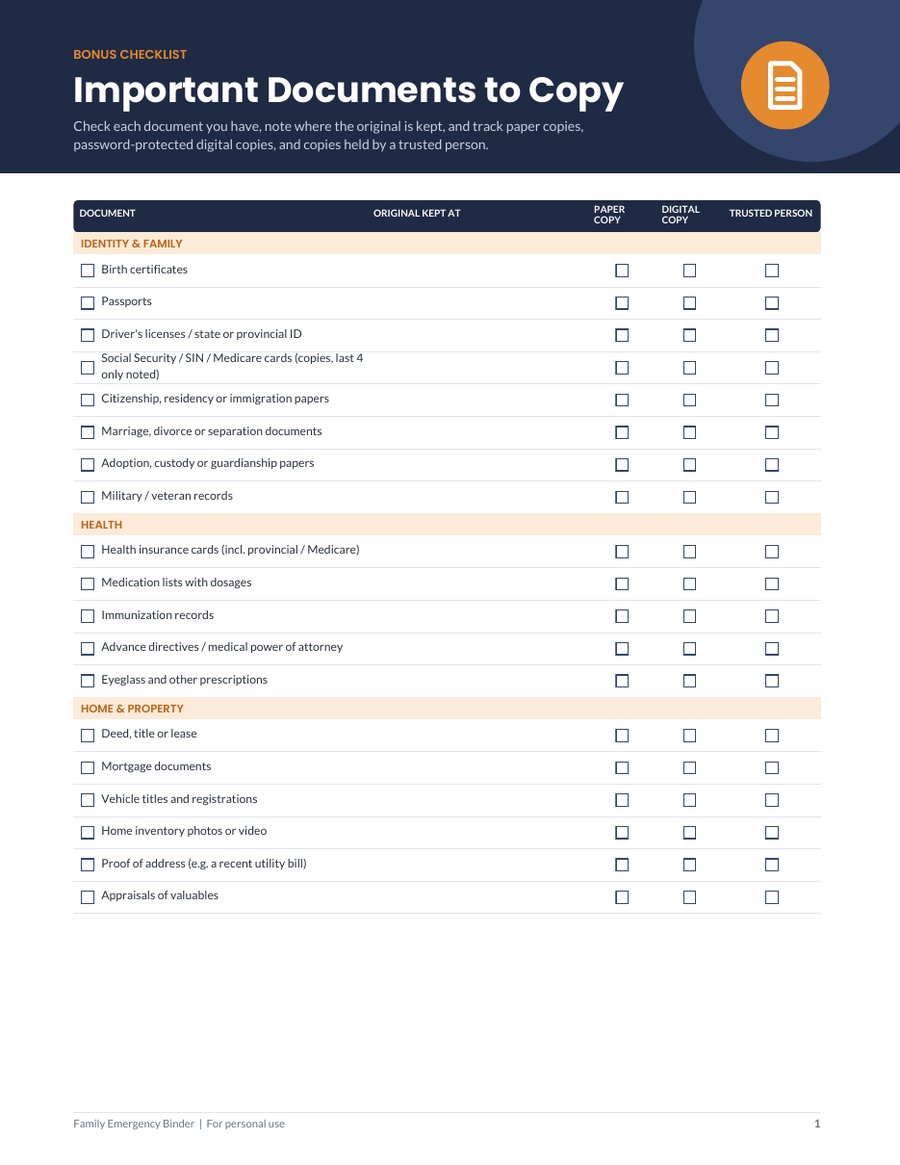
Another practical addition is a two-page checklist to help you identify important records you may want to copy or organize.
Instead of trying to remember every document category yourself, you can work through the list and decide what’s relevant.
Store copies securely and follow applicable privacy, legal, and document-handling requirements.
Preparedness Should Reflect Where You Live
A family in coastal Florida may have different priorities from a household in Alberta or regional Australia.
That’s why the binder includes hazard checklists covering:
- Hurricane / cyclone
- Wildfire / bushfire
- Flood
- Winter storm
- Earthquake
- Long power outage
You can focus on the hazards relevant to your location rather than treating every checklist as equally important.
The kit is designed to support your planning, not replace location-specific instructions.
For real events, always refer to your local emergency management authorities and follow their directions.
Your First 30 Minutes: A Simple Way to Begin
You don’t need an entire afternoon to start using the kit.
Here’s a practical way to begin your first session.
Minutes 1–5: Open your binder. Download the files, open the binder, and explore the clickable contents and section headings. Get familiar with the layout before trying to complete everything.
Minutes 6–12: Add your household details. Start with basic household information and the most important contact details. Fill in what you know. Mark anything that needs checking.
Minutes 13–20: Identify important records. Use the document checklist and binder sections to record where essential paperwork is stored. Don’t enter passwords or full account numbers.
Minutes 21–26: Review your emergency supplies. Open the 72-hour kit checklist. Mark the supplies you already have and note any important gaps.
Minutes 27–30: Choose your next task. Perhaps you’ll complete the pantry inventory, prepare wallet cards, or review a hazard checklist next. Write down that task and a suitable time to return to it.
That’s your first session complete.
Not a fully finished emergency plan.
Not a promise that you’ve anticipated everything.
Just genuine progress toward a more organized household.
And that’s a worthwhile place to begin.
Who This Kit Is Designed For
This digital kit may be a good fit if you:
- Manage important household paperwork and want a clearer system.
- Have children, older family members, or pets whose needs deserve additional planning.
- Want to create a family emergency plan but don’t know where to begin.
- Have downloaded free checklists before but haven’t turned them into one organized resource.
- Prefer fillable documents and printable templates over building your own spreadsheets and forms.
- Want to review emergency supplies and pantry items more systematically.
- Live in the United States, Canada, or Australia and want general preparedness tools you can adapt to local guidance.
You don’t need to be an experienced planner or preparedness enthusiast.
You simply need to be willing to spend some time completing and maintaining the information.
Who This Kit May Not Be For
This kit may not be suitable if you want a professionally customized emergency response plan for a specific property, medical condition, or high-risk situation.
It is not a substitute for local authority instructions, professional evacuation assessments, medical advice, or official emergency alerts.
It’s also not the right purchase if you expect physical supplies, a printed binder delivered to your home, or someone to complete the documents for you.
This is a digital planning resource. You supply your household information, personalize the checklists, and decide how to use and store the files.
A Small, Practical Step Toward Being More Organized
You probably already know that having important information together is a good idea.
The difficult part is often making time to do it.
There are always other priorities: work, groceries, appointments, school, household chores, and the countless little responsibilities that fill your week.
Creating an emergency binder from scratch can easily fall to the bottom of the list.
But it doesn’t have to remain another unfinished project.
With a ready-to-fill system, you can begin with a manageable session and return whenever you have time.
You’ll know which section to open next.
You’ll have a place to record relevant information.
And you’ll have tools for reviewing essential supplies instead of relying on scattered notes.
There’s value in knowing you’ve made a start.
There’s also peace of mind in having a plan you can revisit and improve, even though no plan can account for every circumstance.
For USD17, you can download the complete kit and begin organizing your household information today.
Frequently Asked Questions
Do I need special software?
You’ll need a compatible PDF reader to fill in the binder and wallet cards digitally, or you can print them and complete them by hand.
For the Pantry & Food Storage Planner, you can use Microsoft Excel or Google Sheets.
Some browser PDF viewers may not handle fillable fields consistently, so a dedicated PDF reader may provide a better experience.
Will this work in the United States, Canada, and Australia?
Yes. The kit is intended for households in all three countries.
It includes general preparedness content informed by relevant official guidance, along with hazard categories used across these regions.
You should still adapt your entries to your local conditions, terminology, services, and emergency instructions.
Is it safe to put personal information in the binder?
The binder specifically advises you not to enter full account numbers or passwords.
However, any document containing household, contact, health, or financial reference information should be treated as sensitive.
Use appropriate device security and file storage practices. Be cautious when sharing printed or digital copies, and include only the information necessary for your purposes.
No document format alone can guarantee privacy or security.
Can I print it on A4 paper?
Yes. The binder is formatted for US Letter paper, but you can select “Scale to Fit” or the equivalent fit-to-page setting when printing on A4 paper.
Check the print preview to confirm the layout is suitable before printing the full document.
Is the kit a physical product?
No. This is an instant digital download.
No physical binder, printed pages, food, water, or emergency equipment will be shipped.
You receive digital files that you can use on your devices or print yourself.
Do I need to finish everything at once?
Not at all.
The included Quick Start guide helps you begin in approximately 30 minutes.
You can complete the remaining sections over several sessions and review them as your household information changes.
Does this replace official emergency instructions?
No.
The kit organizes general preparedness information and planning prompts. It does not provide real-time emergency directions or personalized professional advice.
Always follow relevant local authority instructions.
What is the refund policy?
Because this is an instant digital download, all sales are final and refunds are not offered. The one exception: if a file is damaged or will not open, email us at hi@dailywiser.com and we will send a working replacement, or refund you if we cannot fix it.
You Can Start With One Page
Imagine opening one organized document instead of wondering where to begin.
Your household contacts have a dedicated section.
Important record locations have somewhere to be noted.
Your emergency supplies have checklists.
Your pantry has an inventory and rotation planner.
And when something changes, you know where to update it.
You don’t need to make everything perfect.
You don’t need to purchase every suggested supply immediately.
You don’t need to know every possible emergency scenario.
You just need a practical system that helps you make progress at your own pace.
That’s what this kit is here for.
A calmer starting point. A clearer structure. A more organized way to prepare.
Get the Family Emergency Binder + 72-Hour Kit & Pantry Planner
Your complete digital planning kit — USD17, one purchase, instant digital download.
Your download includes the 59-page fillable Family Emergency Binder, 6-page 72-Hour Kit Checklist, 4 fillable wallet cards, Excel/Google Sheets Pantry & Food Storage Planner, 1-page Quick Start guide, and 2-page Important Documents to Copy checklist.
Everything is designed to help you move from scattered information and good intentions to a household plan you can fill in, review, and maintain.
Family Emergency Binder + 72-Hour Kit & Pantry Planner — USD17
General preparedness information only, summarized from official public sources. It is not professional, medical, legal, financial or insurance advice, and it does not guarantee safety. Always follow instructions from your local authorities.